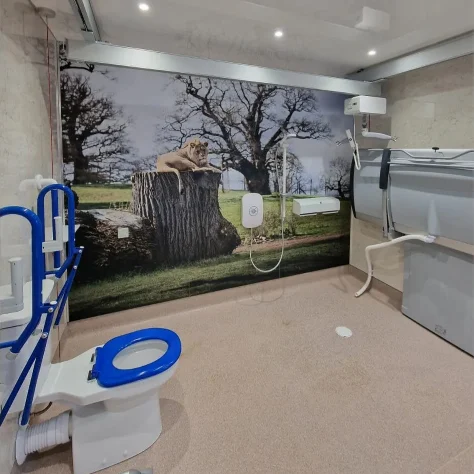
As someone who is both involved with creating accessible toilet facilities in buildings and a carer who requires them, I have quite a rare insight into what’s needed and the lived experience of using them. With both these ‘hats’ in mind, one of my greatest frustrations is improper treatment of the emergency red cord.
The emergency red cord is, as the name suggests, there to allow users to call for assistance should there be an issue. This could easily mean that someone is on the floor and unable to get up, so the red cord needs to extend to that low level to allow anyone in difficulty to reach it. Given that this seems both obvious and logical, you may be surprised to hear that it is very common for the cord to be tied up, hung over grab rails, or even cut short, presumably to keep it ‘out of the way’. Please don’t do this!
We work with Rise Adaptations, who is an innovator in providing Changing Places facilities in almost any space, including listed buildings, outdoor attractions, and small venues. We help them with various aspects of the construction, including planning permission, drawing packages, and building control. We also help to create solutions in difficult and non-standard spaces.
As a carer, this gives me enormous satisfaction and as architectural technologists, it gives us great professional pride in making them work and opening up destinations that would otherwise be difficult for people with disabilities. But we can only do so much, and the continued usefulness of these facilities is determined to a great degree by maintenance and best practice in use of them. Compromising the emergency cord may seem like a small detail but it can have a huge impact, and I see it far too often for my liking. This is down to both users and operators.
Luckily, there are organisations who are equally concerned about this and the Red Cord Card Campaign, organised by disabled access charity, euansguide.com, aims to encourage proper use of the red cord with a simple solution. The Red Cord Card is a pocket-sized, splash-proof notice that attaches to the cord. In an easy-to-read font, it states ‘This red emergency cord must hang freely to the floor. If it does not, it may prevent a disabled person from asking for help’. It just acts as a prompt to anyone using or looking after the accessible toilets that they shouldn’t be moving the cord away from the floor. You can read more about the campaign and order cards on their website. I try to keep a stash with me and whenever I go into a Changing Places, I add one if there isn’t already one there. Hopefully, it makes anyone thinking of moving the cord (and I do appreciate that it’s usually done innocently because it’s ‘in the way’) to leave it in place.
Hopefully, those using Changing Places are usually people with disabilities or carers assisting people with disabilities, and we tend to be aware of the issue. However, other people may use them as baby changing facilities can be located in them (I have comments on this as well, but that’s for a different blog!) and sometimes they can be used by others when other toilets are full or out of service. If you do use them, just double check that the cord is hanging correctly and if it’s not, and you can, put it where it should be. Please also report any issues to staff, especially if it wasn’t something you could correct, such as the cord being cut. This, hopefully, not only allows the issue to be resolved but sends a clear message to those in charge of them that it is important and a cause for concern. Often, best practice is a community endeavour and not something that should only be driven by the minorities that use the facilities.
If you’d like to see more about the accessible facilities that we install, see our Rise Adaptations case study.
Accreditations: BSc (Hons) Architectural Technology, ICIOB – Incorporated Chartered Institute of Building, CIAT affiliate
Skills: Autodesk CAD, project management, specification writing, contract administration, principal designer, knowledge of building regulations, energy performance of buildings, designing for neurodiversity.
About Tony
Tony is the Big Dog of Farrar Bamforth Architecture. Starting his career here in 1999, he acquired the business and became Managing Director in 2018. Tony loves process driven buildings; creating buildings that can make a positive impact on business performance and people’s lives. Tony takes an intuitive approach to architecture and can often be found in buildings waving his hands around to indicate where rooms should go. He’s also a ‘fixer’; solving problems and dealing with the difficult issues others would rather delegate. Think ‘Mr Wolf’ in Pulp Fiction but with building regulations rather than dead bodies.
In his many years with the company, his favourite project so far has been Berendsen Laundry in Durham. A £5million build and £5million fit-out, Tony was involved from start to finish and enjoyed the perfect combination of interesting job, great client, and good team of contractors and consultants.
And finally…
Tony’s favourite toast topping is two rashers of bacon, brown sauce, and another slice of toast. That’s a sandwich Tony (there’s always one 🙄). When not standing in buildings waving his arms around, he can often be found at heavy metal or Adam Ant concerts, supporting Wakefield Trinity, playing touch rugby, or watching bad car chase movies. Though not, apparently, the Fast and the Furious (too bad).
×